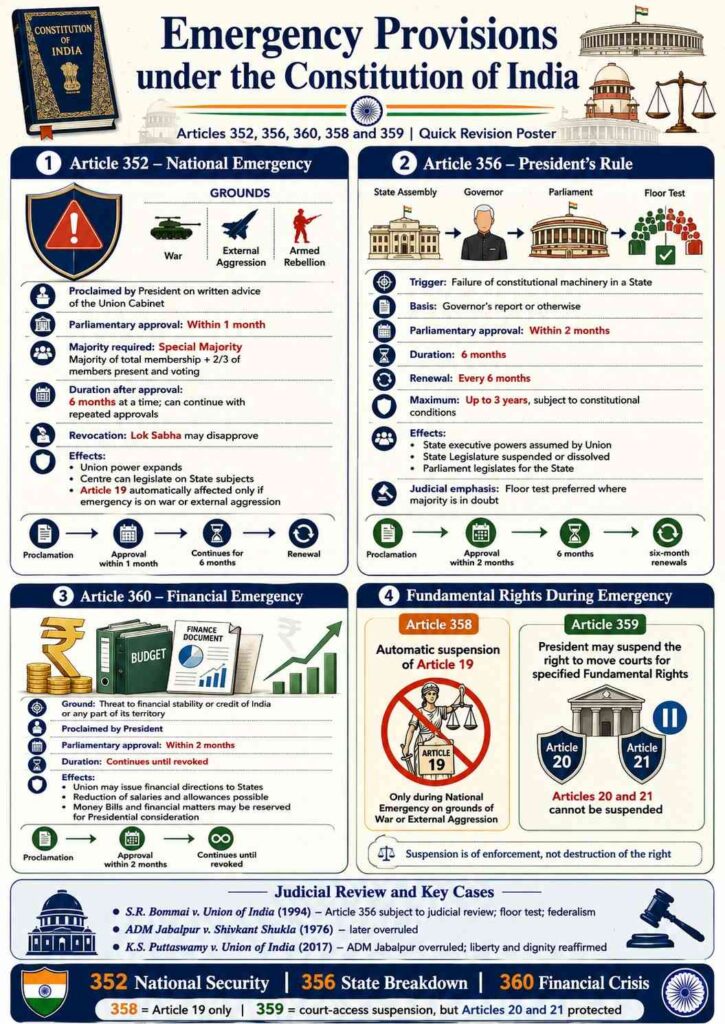
Constitutional Framework and Purpose
🔹 Location and scheme: Emergency provisions are contained in Part XVIII of the Constitution of India (Articles 352–360). They permit a temporary concentration of Union power when the security of India, constitutional government in a State, or the financial stability or credit of India is seriously threatened. Related provisions, especially Articles 250, 251, 353, 354, 355, 357, 358 and 359, determine their consequences.
🔹 Three constitutional situations: The Constitution recognises three distinct forms of emergency: National Emergency under Article 352; President’s Rule or State Emergency under Article 356; and Financial Emergency under Article 360. They differ in their grounds, approval procedure, duration, effect on Union–State relations, and impact on fundamental rights.
🔹 Exceptional character: Emergency powers are exceptional powers, not ordinary tools of political administration. Their exercise must remain consistent with constitutionalism, federalism, democracy, judicial review and the rule of law. The Constitution therefore prescribes parliamentary approval, limited duration, and—after the Forty-fourth Amendment—substantial safeguards against misuse.
Historical Development and Constitutional Safeguards
🔹 Original position: Originally, Article 352 permitted National Emergency on the grounds of war, external aggression or internal disturbance. The expression “internal disturbance” was considerably broader than the present expression “armed rebellion.”
🔹 Thirty-eighth Amendment, 1975: The Constitution (Thirty-eighth Amendment) Act, 1975 attempted to make the President’s satisfaction under Articles 352, 356 and 360 final and conclusive, thereby excluding judicial scrutiny. This was part of a period in which emergency powers were expanded substantially.
🔹 Forty-fourth Amendment, 1978: The Constitution (Forty-fourth Amendment) Act, 1978 introduced the principal modern safeguards. It replaced “internal disturbance” with “armed rebellion” in Article 352; required the Union Cabinet’s decision in writing; reduced the initial approval period; restored periodic parliamentary control; protected Articles 20 and 21 from suspension under Article 359; and limited the automatic suspension of Article 19 to emergencies based only on war or external aggression.
🔹 Basic structure limitation: In Kesavananda Bharati v. State of Kerala, (1973) 4 SCC 225; 1973 Supp SCR 1, the petition challenged constitutional amendments affecting property and land-reform laws. The principal issue was whether Parliament’s amending power under Article 368 was unlimited. The Supreme Court held that Parliament may amend the Constitution, but cannot destroy its basic structure. This doctrine protects features such as constitutional supremacy, judicial review, democracy, federalism and limited government; consequently, emergency-related amendments or actions cannot lawfully destroy these foundational features.
🔹 Limited amending power: In Minerva Mills Ltd. v. Union of India, (1980) 3 SCC 625, the validity of parts of the Forty-second Amendment was challenged. The Supreme Court held that limited amending power and judicial review form part of the basic structure. It also stressed harmony between Fundamental Rights and Directive Principles. The case is important because it confirms that neither Parliament nor the executive can use constitutional power to create an uncontrolled authority beyond judicial scrutiny.
National Emergency under Article 352
Grounds for Proclamation
🔹 Security threat: Article 352 permits the President to proclaim a National Emergency when a grave emergency exists whereby the security of India or any part of its territory is threatened by war, external aggression or armed rebellion. The emergency may cover the whole of India or only a specified part of India.
🔹 Imminent danger: A proclamation may be issued even before the actual occurrence of war, external aggression or armed rebellion, provided the President is satisfied that there is an imminent danger of such event. Thus, the Constitution permits preventive action, but only in a situation of genuine and grave constitutional danger.
🔹 Meaning of war: War generally refers to an armed conflict involving India and another country. A formal declaration of war is not always necessary if the factual circumstances establish a grave threat to national security.
🔹 Meaning of external aggression: External aggression covers hostile action from outside India even where the situation may not formally amount to war. It may include invasion, armed attack or similar external hostility.
🔹 Meaning of armed rebellion: Armed rebellion requires a serious, organised and armed challenge to the authority of the State. It is narrower than the earlier phrase “internal disturbance.” Ordinary political protests, public disorder, strikes, riots or non-violent agitation do not by themselves amount to armed rebellion.
Procedure and Parliamentary Control
🔹 Written Cabinet decision: The President cannot issue or vary a National Emergency merely on informal ministerial advice. Article 352(3) requires that the decision of the Union Cabinet, consisting of the Prime Minister and Cabinet-rank Ministers, must be communicated to the President in writing. This safeguard was introduced after the experience of the 1975 Emergency.
🔹 Approval within one month: Every proclamation must be laid before both Houses of Parliament. It ceases after one month unless both Houses approve it within that period. Where the Lok Sabha is dissolved, special constitutional arrangements apply after its reconstitution.
🔹 Special majority: Approval or continuation requires a special majority in each House: a majority of the total membership of that House and a majority of not less than two-thirds of members present and voting. This is more stringent than the approval required for President’s Rule or Financial Emergency.
🔹 Six-month renewal: Once approved, a National Emergency remains in force for six months. It may continue for further six-month periods only if both Houses pass fresh resolutions with the required special majority.
🔹 Lok Sabha disapproval: The President must revoke the Emergency if the Lok Sabha passes a resolution disapproving it or its continuation. Further, where at least one-tenth of the total Lok Sabha membership gives written notice of such a resolution, a special sitting must be convened within fourteen days.
Effects of National Emergency
| Area affected | Constitutional consequence |
|---|---|
| Executive power | Union executive may direct States regarding exercise of State executive power. |
| Legislative power | Parliament may legislate on subjects in the State List. |
| Union–State relations | Federal distribution of executive and legislative powers becomes more centralised. |
| Financial relations | The President may modify the operation of provisions relating to distribution of revenues between Union and States. |
| Legislature duration | Parliament may extend the life of Lok Sabha and State Legislative Assemblies by law, one year at a time, subject to constitutional limits. |
🔹 Union directions: Under Article 353(a), the Union executive power expands to giving directions to any State regarding the manner in which its executive power must be exercised. This does not abolish State governments, but it places them under enhanced Union control.
🔹 Parliament on State List: Under Article 250, Parliament may legislate on any matter in the State List during a National Emergency. Such a law ordinarily ceases to have effect six months after the Emergency ends, except for actions already done under it. If a State law conflicts with a parliamentary law made under Article 250, the parliamentary law prevails during its operation.
🔹 Revenue distribution: Article 354 permits the President to modify the operation of Articles 268–279, which concern financial distribution between the Union and States. Such modification cannot ordinarily extend beyond the financial year in which the Emergency ceases.
🔹 Extension of legislative tenure: During a National Emergency, Parliament may extend the term of the Lok Sabha under Article 83(2) and the term of State Legislative Assemblies under Article 172(1), for not more than one year at a time. Such extension cannot continue beyond six months after the Emergency has ceased.
Historical Use of Article 352
🔹 Past proclamations: National Emergency has been proclaimed on three occasions: during the 1962 conflict with China, during the 1971 conflict with Pakistan, and during the 1975–1977 Emergency declared on the ground of internal disturbance under the then-existing text of Article 352. The 1975 Emergency lasted from 25 June 1975 to 21 March 1977.
🔹 Current constitutional position: The post-1978 requirement of armed rebellion, written Cabinet advice, special parliamentary majority and protection for Articles 20 and 21 makes the present framework materially more restrictive than the one operating in 1975.
President’s Rule or State Emergency under Article 356
Constitutional Basis
🔹 Failure of constitutional machinery: Article 356 applies where the President is satisfied that the government of a State cannot be carried on in accordance with the Constitution. The President may act on the Governor’s report or otherwise; therefore, a Governor’s report is important but not an indispensable constitutional requirement.
🔹 Article 355 connection: Article 355 imposes a duty on the Union to protect every State against external aggression and internal disturbance and to ensure that its government is carried on according to the Constitution. However, Article 355 does not independently authorise a Union takeover; Article 356 can be invoked only when its own constitutional conditions are satisfied.
Nature and Scope of President’s Rule
🔹 Executive takeover: The President may assume all or any functions of the State Government and powers exercisable by the Governor or another State authority. In practice, the Governor ordinarily administers the State on behalf of the President.
🔹 Legislative takeover: The President may declare that the powers of the State Legislature shall be exercisable by or under the authority of Parliament. Parliament may then make laws for the State or authorise the President or another authority to do so under Article 357.
🔹 High Court protection: Article 356 expressly prohibits the President from assuming powers vested in a High Court or suspending constitutional provisions relating to High Courts. Thus, President’s Rule cannot lawfully extinguish the constitutional role of the High Court.
🔹 Suspended animation and dissolution: A State Legislative Assembly may be kept in suspended animation or dissolved. Dissolution is constitutionally more serious because it ends the existing elected Assembly. Under the principles in S.R. Bommai, irreversible dissolution should not ordinarily occur before parliamentary approval of the proclamation.
🔹 Continuity of laws: A law made by Parliament, the President or another authorised authority during President’s Rule continues even after the proclamation ends until it is altered, repealed or amended by a competent legislature or authority.
Approval, Duration and Extension
🔹 Approval within two months: A proclamation under Article 356 must be approved by both Houses of Parliament within two months; otherwise, it ceases to operate. Approval is by ordinary parliamentary majority, not the special majority required under Article 352.
🔹 Six-month periods: Once approved, President’s Rule continues for six months. It may be extended every six months through fresh parliamentary approval.
🔹 Maximum period: President’s Rule cannot ordinarily continue beyond three years. Beyond one year, continuation is permitted only when: a National Emergency is in operation in the whole or any part of India, and the Election Commission certifies that elections to the concerned State Legislative Assembly cannot be held due to difficulties.
Judicial Review of Article 356
🔹 Leading authority — S.R. Bommai v. Union of India, (1994) 3 SCC 1; AIR 1994 SC 1918: Several State governments, including the Karnataka government led by S.R. Bommai, were dismissed under Article 356 and the proclamations were challenged. The central issue was whether the President’s satisfaction was beyond judicial review. A nine-Judge Bench held that Article 356 is subject to judicial review. The Court may examine whether relevant material existed, whether the material was relevant, whether the power was exercised mala fide, or whether the proclamation was based on extraneous or wholly irrational grounds. The Court also held that federalism and secularism are basic features, that a floor test is normally the proper method for deciding whether a Ministry enjoys majority support, and that a court may restore a dismissed government or Assembly if the proclamation is invalid.
🔹 Floor-test principle: A Governor should not ordinarily determine majority by private assessment, political correspondence or allegations of defections. Where the question is whether a Ministry has lost majority, the constitutional forum is ordinarily the floor of the Legislative Assembly. The Supreme Court has repeatedly treated the floor test as the proper democratic method for resolving such disputes.
🔹 Leading authority — Rameshwar Prasad (VI) v. Union of India, (2006) 2 SCC 1: In this case, the Bihar Legislative Assembly was dissolved before it first met, based on a Governor’s report alleging attempts to form a government through unconstitutional defections. The Supreme Court examined whether the material justified the proclamation and dissolution. It held that the dissolution was unconstitutional because the Governor’s report rested on irrelevant and extraneous material and prevented a possible government from proving majority on the floor of the House. Although the Court declined restoration because elections had substantially progressed, it reaffirmed that Article 356 cannot be used on political suspicion or speculative assessment.
🔹 No automatic suspension of rights: President’s Rule does not automatically suspend Fundamental Rights, dissolve courts, or suspend the Constitution of the State. It is a temporary assumption of executive and legislative authority, subject to parliamentary approval and judicial review.
Financial Emergency under Article 360
Grounds and Procedure
🔹 Financial instability: Article 360 permits the President to proclaim Financial Emergency where the financial stability or credit of India, or any part of its territory, is threatened. The provision can therefore apply to a crisis affecting the whole country or a particular region.
🔹 Parliamentary approval: The proclamation must be laid before both Houses and must be approved within two months. If approved, it continues until revoked; unlike Article 352 and Article 356, Article 360 does not prescribe a six-month renewal requirement or a maximum duration.
Effects of Financial Emergency
🔹 Financial propriety directions: The Union may direct States to observe specified canons of financial propriety. This can include directions concerning expenditure, borrowing, salary structures and fiscal administration.
🔹 Reduction of salaries: Directions may require reduction of salaries and allowances of State employees. They may also require reduction of salaries and allowances of Union employees, including Judges of the Supreme Court and High Courts.
🔹 Reservation of State Bills: The President may direct that all Money Bills and other Bills covered by Article 207, after being passed by the State Legislature, must be reserved for the President’s consideration. This creates substantial Union control over State financial legislation.
🔹 Practical position: No Financial Emergency has been proclaimed in India so far. Government material has consistently treated Article 360 as an unused constitutional power.
Fundamental Rights During National Emergency
Article 358: Effect on Article 19
🔹 Automatic operation: Article 358 operates automatically when a National Emergency is declared on the ground of war or external aggression. It does not apply where the Emergency is based only on armed rebellion.
🔹 Limited scope: During such Emergency, Article 19 does not restrict the legislative or executive power of the State. However, the law or executive action must be connected with the Emergency and must satisfy the constitutional recital requirement introduced by the Forty-fourth Amendment.
🔹 Post-emergency effect: A law made under Article 358 ceases to have effect after the Emergency ends to the extent it would otherwise violate Article 19. However, acts already done or omitted during the Emergency remain protected.
Article 359: Suspension of Enforcement of Selected Rights
🔹 Presidential order required: Article 359 does not operate automatically. During a National Emergency, the President may issue a separate order suspending the right to move a court for enforcement of specified Fundamental Rights. The order may apply to the whole or a part of India.
🔹 Articles 20 and 21 protected: After the Forty-fourth Amendment, an Article 359 order cannot suspend enforcement of Article 20 or Article 21. Therefore, protection against ex post facto criminal laws, double jeopardy, self-incrimination, and deprivation of life or personal liberty except by procedure established by law remains judicially enforceable even during National Emergency.
🔹 Difference from Article 358: Article 358 concerns the operation of Article 19 and applies automatically only in war or external-aggression emergencies. Article 359 concerns access to courts for enforcement of specifically named Part III rights and requires a Presidential Order.
| Point of distinction | Article 358 | Article 359 |
|---|---|---|
| Operation | Automatic | Requires Presidential Order |
| Applicable emergency | War or external aggression only | Any National Emergency |
| Rights affected | Article 19 only | Specified Part III rights, except Articles 20 and 21 |
| Nature | Article 19 does not restrict State action | Enforcement through courts is suspended for listed rights |
| Protection after Forty-fourth Amendment | Does not apply to armed rebellion | Articles 20 and 21 cannot be included |
🔹 Leading authority — Makhan Singh v. State of Punjab, AIR 1964 SC 381; (1964) 4 SCR 797: Several detainees challenged detention during the 1962 Emergency after a Presidential Order under Article 359 suspended enforcement of certain Fundamental Rights. The issue was whether all legal challenges were barred. The Supreme Court held that an Article 359 order suspends the right to enforce the specified Fundamental Rights, but does not destroy all legal remedies. A challenge based on statutory non-compliance, lack of authority, jurisdictional error or a ground independent of the suspended Fundamental Right may still be maintainable.
🔹 Leading authority — Additional District Magistrate, Jabalpur v. Shivkant Shukla, (1976) 2 SCC 521; AIR 1976 SC 1207: During the 1975 Emergency, detained persons sought habeas corpus petitions challenging preventive detention. By a majority of four to one, the Supreme Court held that, because of the Article 359 Presidential Order, detenues could not seek judicial enforcement of personal liberty through habeas corpus. Justice H.R. Khanna dissented, holding that rule of law and liberty cannot be wholly extinguished by executive action. The majority decision became a symbol of constitutional failure during the Emergency.
🔹 Leading authority — K.S. Puttaswamy (Retd.) v. Union of India, (2017) 10 SCC 1: The case concerned whether privacy is a Fundamental Right. A nine-Judge Bench held that privacy is protected under Part III and expressly overruled the majority view in ADM Jabalpur. The Court recognised that life and personal liberty are not gifts of the Constitution but pre-existing human rights recognised and protected by it. The decision constitutionally vindicated Justice H.R. Khanna’s dissent and reaffirmed that executive power remains subject to legality and judicial review.
Judicial Review and Constitutional Limits
🔹 No absolute presidential satisfaction: The present constitutional text does not contain the Thirty-eighth Amendment’s finality clauses that attempted to exclude review of the President’s satisfaction. Thus, proclamations cannot claim immunity merely because they are based on presidential satisfaction.
🔹 Review standard: Judicial review does not permit courts to substitute their political judgment for that of the executive. However, courts can examine whether constitutional power was exercised in bad faith, on no material, on irrelevant material, for an improper purpose, or in a manner that is manifestly arbitrary.
🔹 Material versus ministerial advice: Article 74(2) protects the advice tendered by Ministers to the President from judicial inquiry. Yet, under S.R. Bommai, courts can examine the factual material said to justify a proclamation under Article 356. The government cannot avoid review merely by characterising every supporting fact as protected Cabinet advice.
🔹 Federalism and democracy: Emergency powers alter the normal federal balance, but they cannot lawfully be used to destroy federalism, secularism, representative democracy or judicial review. These are basic constitutional commitments, not temporary privileges.
Quick Revision Memory Aid
🔹 “352–356–360” formula:
352 = National security crisis
356 = State constitutional breakdown
360 = Financial instability
🔹 “War–Aggression–Rebellion” formula for Article 352:
War = armed conflict
External aggression = hostile external attack
Armed rebellion = organised armed internal challenge
🔹 “One–Two–Two” approval formula:
Article 352: approval within one month
Article 356: approval within two months
Article 360: approval within two months
🔹 “19–20–21” rights formula:
Article 358: affects Article 19 only, and only in war/external aggression.
Article 359: may suspend enforcement of selected rights, but never Articles 20 and 21.