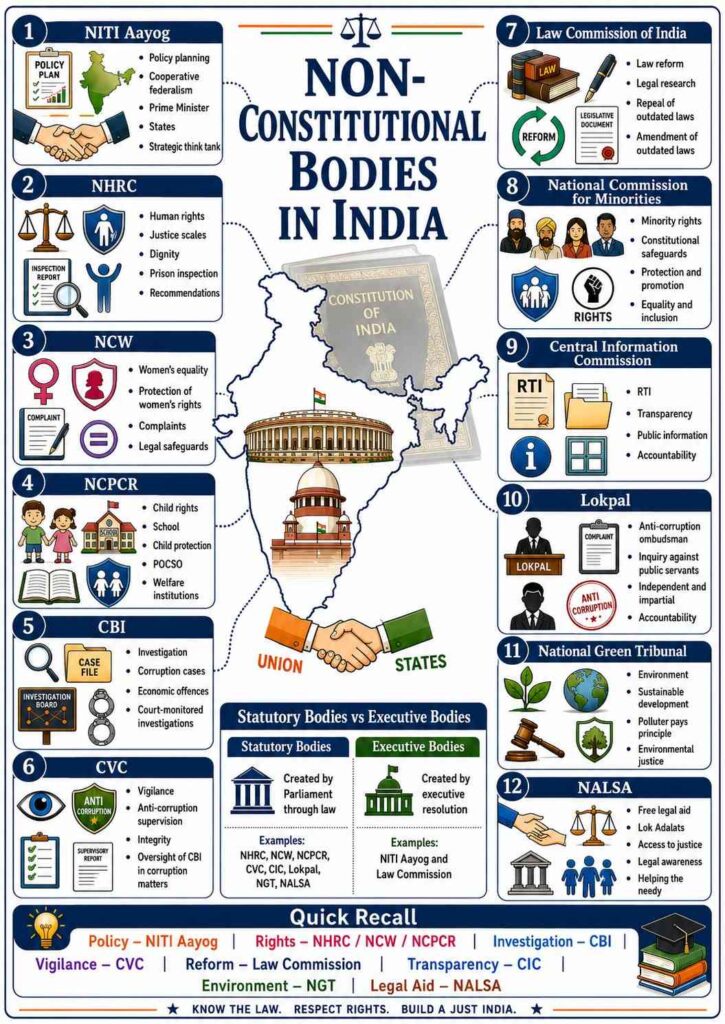
Meaning and Constitutional Position of Non-Constitutional Bodies
• Core concept: A non-constitutional body is not created directly by the Constitution of India. It may be created either by a statute enacted by Parliament or a State Legislature, or by an executive resolution, notification, or order of the Government.
• Statutory body: A statutory body derives its existence, powers, membership, functions, and limits from an Act. Examples include the NHRC, NCW, NCPCR, CVC, NCM, CIC, Lokpal, NGT and NALSA. Such bodies cannot act beyond the powers granted by their parent statute; this is known as the principle of ultra vires.
• Executive body: An executive body is created through executive action rather than legislation. NITI Aayog and the Law Commission of India are important examples. Their existence may be altered, reconstituted, or discontinued by executive decision, subject to constitutional limitations and judicial review.
• Constitutional control: “Non-constitutional” does not mean unimportant or uncontrolled. Every such body remains subject to the Constitution, especially Articles 14, 19 and 21 where applicable, principles of natural justice, legislative oversight, financial accountability, and judicial review under Articles 32 and 226.
• Case law — Rai Sahib Ram Jawaya Kapur v. State of Punjab, AIR 1955 SC 549; 1955 SCR 225: Private textbook publishers challenged Punjab’s executive policy of taking over textbook publication without a specific statute. The issue was whether executive power can operate in an area where no legislation exists. The Supreme Court held that executive power extends to matters within the Legislature’s competence, provided executive action does not violate the Constitution, an existing law, or legal rights. This decision explains the constitutional foundation of executive institutions such as NITI Aayog and the Law Commission.
| Basis of comparison | Statutory body | Executive body |
|---|---|---|
| Source | Act of Parliament or State Legislature | Cabinet resolution, notification, executive order |
| Examples | NHRC, NCW, CBI’s statutory police framework, CVC, NGT | NITI Aayog, Law Commission |
| Powers | Limited by the parent statute | Limited by Constitution, executive competence and government mandate |
| Alteration or abolition | Usually requires legislative amendment or repeal | Can ordinarily be restructured by executive action |
| Accountability | Statute, Parliament, courts, audits and reports | Executive, Parliament, courts and public-law review |
NITI Aayog
• Nature: NITI Aayog, meaning the National Institution for Transforming India, is an executive policy institution and not a statutory or constitutional body. It was constituted by a Union Cabinet Resolution dated 1 January 2015, replacing the Planning Commission, which had been created by a resolution of 15 March 1950.
• Purpose: NITI Aayog functions as the Government of India’s policy think tank. Its objective is to promote long-term strategic planning, innovation, data-based policymaking, cooperative federalism, sustainable development, and coordination between the Union and States.
• Cooperative federalism: Its Governing Council includes Chief Ministers of States and Lieutenant Governors of Union Territories. This institutional design is meant to involve States in national policy formulation rather than treating them merely as recipients of centrally designed plans.
• Original structure: The Cabinet Resolution provides for the Prime Minister as Chairperson, a Governing Council, Regional Councils for specific issues, a Vice-Chairperson appointed by the Prime Minister, full-time members, part-time members, ex officio Union Ministers, a Chief Executive Officer, and a secretariat. Membership may be reconstituted by the Government from time to time.
• Functions: NITI Aayog develops national policy frameworks, promotes village-level planning, supports innovation, monitors implementation, encourages knowledge-sharing among States, and identifies inter-sectoral policy problems. It is primarily advisory and coordination-oriented.
• Limitation: NITI Aayog cannot enact laws, impose taxes, investigate crimes, or issue judicially enforceable orders. Its recommendations gain force only when accepted through executive action, legislation, budgetary allocation, or binding governmental policy.
• Planning Commission distinction: The Planning Commission was associated with centrally administered Five-Year Plans and allocation-oriented planning. NITI Aayog is intended to be more flexible, consultative, federal, and policy-driven rather than functioning as a central planning authority.
National Human Rights Commission
• Statutory source: The National Human Rights Commission is established under the Protection of Human Rights Act, 1993. It is a statutory human-rights institution, not a constitutional court. The Act defines “human rights” as rights relating to life, liberty, equality and dignity guaranteed by the Constitution or embodied in international covenants and enforceable by courts in India.
• Composition: The Act creates a Chairperson and Members with judicial and human-rights expertise. The statutory structure also connects the Commission with other human-rights-related bodies through ex officio participation as prescribed by law.
• Inquiry power: Under Section 12, the NHRC may inquire, suo motu, on a petition, or on a court’s direction into a violation of human rights, abetment of violation, or negligence by a public servant in preventing violation. It may also inspect jails and institutions, study safeguards, review laws, promote research, spread awareness, and examine international human-rights instruments.
• Civil-court powers: During an inquiry, the NHRC has powers similar to those of a civil court, including summoning witnesses, receiving evidence on affidavit, calling for documents, and requisitioning public records. It may use investigating agencies, subject to statutory conditions.
• Recommendations: The NHRC may recommend compensation or interim relief, prosecution or disciplinary action against responsible persons, and other remedial measures. Its recommendations are influential but ordinarily do not operate like a court decree; the concerned government must respond within the statutory framework.
• Limitation period: Section 36(2) bars the NHRC from inquiring into matters occurring more than one year before the complaint, subject to the statutory interpretation given by the Supreme Court.
• Case law — N.C. Dhoundial v. Union of India, (2004) 2 SCC 579: A complaint alleging illegal detention by the CBI was taken up by the NHRC after the expiry of one year from the alleged incident. The legal issue was whether the one-year restriction under Section 36(2) was merely procedural or a jurisdictional limitation. The Supreme Court held that the restriction is mandatory and jurisdictional; the NHRC cannot inquire into a matter beyond that period. The case emphasises that even human-rights bodies must remain within statutory limits.
National Commission for Women
• Statutory source: The National Commission for Women is constituted under the National Commission for Women Act, 1990. It is a statutory body designed to protect and advance women’s rights and interests.
• Composition: The Commission consists of a Chairperson, five Members, and a Member-Secretary, appointed according to the statutory scheme. The design seeks representation of persons having experience in law, women’s welfare, administration, labour, education, health, and related fields.
• Safeguards review: Under Section 10, the NCW investigates and examines constitutional and legal safeguards available to women and recommends measures for effective implementation. It can report to the Central Government on the working of those safeguards.
• Complaints and suo motu action: The NCW may take up cases involving violation of women’s rights, non-implementation of laws intended to protect women, denial of equality, harassment, discrimination, dowry-related concerns, violence, and similar grievances. It may also act suo motu where a serious issue affects women generally.
• Law-reform role: The Commission reviews existing laws, identifies gaps, recommends amendments, conducts studies, promotes research, and advises governments on policies affecting women.
• Nature of power: The NCW is not a criminal court or a regular civil court. It does not itself convict an offender or award a criminal sentence. Its major strength lies in inquiry, recommendations, fact-finding, policy intervention, coordination with authorities, and public accountability.
• Constitutional connection: The work of the NCW is linked with Articles 14, 15, 16 and 21. Article 15(3) specifically permits the State to make special provisions for women and children; this constitutional permission supports protective legislation and institutional mechanisms for substantive equality.
National Commission for Protection of Child Rights
• Statutory source: The National Commission for Protection of Child Rights is established under the Commissions for Protection of Child Rights Act, 2005. The Act also provides for State Commissions and Children’s Courts for speedy trial of offences against children.
• Child-rights approach: The Act treats child rights in light of the United Nations Convention on the Rights of the Child, 1989, ratified by India on 11 December 1992. It aims to ensure that laws, policies, programmes and administrative systems protect the survival, development, dignity, participation and safety of children.
• Core functions: The NCPCR examines safeguards for children, investigates violations, studies laws and policies, reviews implementation, inspects child-care institutions, promotes child-rights literacy, and inquires into complaints or takes suo motu notice of deprivation or violation of child rights.
• Vulnerable children: It gives special attention to children affected by trafficking, sexual abuse, child labour, armed conflict, disability, displacement, poverty, disaster, conflict with law, and institutional neglect.
• Relationship with other laws: The NCPCR works alongside the Right of Children to Free and Compulsory Education Act, 2009, the Juvenile Justice (Care and Protection of Children) Act, 2015, and the Protection of Children from Sexual Offences Act, 2012. It does not replace police investigation, prosecution, child welfare committees, or criminal courts.
• Children’s Courts: The Act permits States to establish or designate Children’s Courts for speedy trial of offences against children. This reflects the principle that child-sensitive justice requires specialised and prompt procedures.
Central Bureau of Investigation
• Institutional origin: The CBI is not created by a standalone “CBI Act.” It was established through a Ministry of Home Affairs Resolution dated 1 April 1963. Its police and investigative powers are exercised through the Delhi Special Police Establishment Act, 1946. Therefore, the CBI is executive in institutional origin but has statutory investigative authority under the DSPE Act.
• DSPE framework: The Delhi Special Police Establishment Act authorises the DSPE to investigate notified offences. The CBI functions through this statutory framework, particularly in corruption cases, major economic offences, special crimes, and cases transferred by constitutional courts.
• State consent: Section 6 of the DSPE Act generally requires consent of the State Government for exercise of DSPE powers within that State. This protects federalism by recognising that “police” and “public order” are primarily State subjects.
• Court-directed investigation: The consent requirement does not prevent the Supreme Court or a High Court from ordering a CBI investigation in exceptional cases while exercising powers under Articles 32 and 226.
• Director’s independence: The Director of CBI is appointed under the statutory selection process involving the Prime Minister, the Leader of Opposition in the Lok Sabha or leader of the largest opposition party, and the Chief Justice of India or a Supreme Court Judge nominated by the Chief Justice. The law provides tenure protection, including a minimum tenure and regulated extension provisions.
• Case law — State of West Bengal v. Committee for Protection of Democratic Rights, West Bengal, (2010) 3 SCC 571: The Calcutta High Court ordered a CBI investigation into allegations involving State police despite the State’s objection. The issue was whether High Courts and the Supreme Court may direct a CBI investigation without State consent under Section 6 of the DSPE Act. The Supreme Court held that constitutional courts may do so under Articles 32 and 226 to protect fundamental rights and ensure justice, but this extraordinary power must be exercised sparingly, cautiously and only where credible circumstances justify it.
• Case law — Subramanian Swamy v. Director, Central Bureau of Investigation, (2014) 8 SCC 682: Section 6A of the DSPE Act required prior approval of the Central Government before inquiry or investigation into certain corruption allegations against officers of Joint Secretary rank and above. The issue was whether seniority-based protection from corruption investigation violated Article 14. The Supreme Court struck down Section 6A as unconstitutional, holding that rank or status cannot create an impermissible shield against investigation into corruption.
Central Vigilance Commission
• Statutory source: The Central Vigilance Commission became a statutory body under the Central Vigilance Commission Act, 2003. It is a central anti-corruption oversight institution and is distinct from the CBI.
• Composition and appointment: The Commission consists of a Central Vigilance Commissioner and up to two Vigilance Commissioners. Appointment is made by the President on the recommendation of a committee comprising the Prime Minister, the Minister of Home Affairs, and the Leader of Opposition in the Lok Sabha or the leader of the largest opposition group.
• Removal safeguard: The Central Vigilance Commissioner and Vigilance Commissioners have statutory security of tenure. Removal for proved misbehaviour or incapacity requires a Supreme Court inquiry and Presidential action, except in specific statutory situations.
• Superintendence over CBI: The CVC exercises superintendence over DSPE investigations into offences under the Prevention of Corruption Act, 1988. However, it cannot direct the CBI regarding the manner in which a particular investigation should be conducted. This balances oversight with investigative autonomy.
• Other functions: The CVC reviews corruption investigations, monitors delays in sanction for prosecution, advises Central Government departments and organisations on vigilance administration, and supervises preventive vigilance mechanisms.
• Case law — Vineet Narain v. Union of India, (1998) 1 SCC 226: The case arose from allegations connected with the “Jain Hawala Diaries” and the perceived inaction of investigative agencies against influential persons. The central issue was how to secure integrity and independence in corruption investigation. The Supreme Court issued extensive directions to insulate the CBI and CVC from improper political interference, emphasising fixed tenure, professional autonomy, transparent supervision and institutional accountability. The later CVC Act, 2003 gave statutory shape to significant parts of this institutional framework.
• Case law — Centre for Public Interest Litigation v. Union of India, (2011) 4 SCC 1: The appointment of P.J. Thomas as Central Vigilance Commissioner was challenged because of pending allegations connected with the Palmolein import matter. The issue was whether the high-powered selection committee could ignore relevant material concerning integrity. The Supreme Court quashed the appointment and held that selection must be based on “institutional integrity,” not merely formal eligibility. The selection committee must make an informed and objective assessment of the candidate’s record.
Law Commission of India
• Nature: The Law Commission of India is a non-statutory and advisory law-reform body. It is constituted by the Ministry of Law and Justice, Department of Legal Affairs, through executive notification and specific terms of reference.
• Main role: It researches legal problems, studies outdated or inconsistent laws, considers judicial developments, consults stakeholders, and submits reports recommending reform, repeal, consolidation, codification or modernisation of laws.
• No legislative power: A Law Commission report is persuasive and influential, but it does not become law merely because the Commission recommends it. Legislative change requires Parliament or the relevant State Legislature to enact an amendment or new law.
• Current institutional point: The official website records the Twenty-Third Law Commission and related appointment notifications. The constitutional point remains that every Commission operates for a defined tenure and on terms set by executive notification; it is not a permanent constitutional authority.
• Importance: Many major reforms in criminal law, evidence law, electoral law, family law, administrative law and judicial administration have been shaped by Law Commission reports, even though implementation depends on governmental and legislative action.
National Commission for Minorities
• Statutory source: The National Commission for Minorities is established under the National Commission for Minorities Act, 1992. It is a statutory body concerned with the protection of minority rights and safeguards.
• Functions: It evaluates the progress of development of minorities, monitors implementation of constitutional and legal safeguards, makes recommendations to governments, studies discrimination, and considers complaints relating to deprivation of minority rights.
• Accountability mechanism: Reports and recommendations of the Commission are placed before Parliament or the concerned State Legislature along with a memorandum indicating action taken or reasons for non-acceptance. This promotes legislative accountability even where the recommendations are not directly enforceable.
Central Information Commission
• Statutory source: The Central Information Commission is established under the Right to Information Act, 2005. It is a statutory quasi-judicial body responsible for enforcing transparency obligations of Central public authorities.
• Jurisdiction: It hears complaints under Section 18 and second appeals under Section 19 relating to Central public authorities. State Information Commissions perform a similar role for State public authorities.
• Powers: The CIC may require disclosure of information, direct compliance with the RTI Act, award compensation in suitable cases, and impose penalties on Public Information Officers for unjustified refusal, delay, malafide denial or destruction of information.
• Case law — Central Public Information Officer, Supreme Court of India v. Subhash Chandra Agarwal, (2020) 5 SCC 481: The case concerned RTI requests relating to the office of the Chief Justice of India, collegium correspondence and judges’ asset declarations. The issue was whether the office of the Chief Justice of India is a “public authority” under the RTI Act and how transparency should be balanced with privacy and judicial independence. The Supreme Court held that the office of the Chief Justice of India is a public authority, but disclosure must be decided case by case by applying statutory exemptions, privacy principles and the public-interest test.
Lokpal and Lokayuktas
• Statutory source: The Lokpal and Lokayuktas Act, 2013 creates the Lokpal at the Union level and requires States to establish Lokayuktas. It is a statutory anti-corruption institution.
• Composition: The Lokpal consists of a Chairperson and up to eight Members, with statutory requirements concerning judicial members and representation. The Chairperson may be a former Chief Justice of India, former Supreme Court Judge, or an eminent person meeting statutory conditions.
• Function: The Lokpal may inquire into allegations of corruption against specified categories of public servants, use or direct inquiry and investigation mechanisms under the Act, and recommend prosecution or disciplinary action where warranted.
• Distinction from CBI and CVC: The Lokpal is an anti-corruption ombudsman. The CBI is an investigating agency. The CVC performs vigilance oversight and supervision in defined areas. These institutions may interact, but none is a complete substitute for the others.
• Case law — Common Cause (A Registered Society) v. Union of India, (2017) 7 SCC 158: The delay in appointing the Lokpal was challenged on the ground that there was no recognised Leader of Opposition in the Lok Sabha. The issue was whether absence of a formally recognised Leader of Opposition made the selection process impossible. The Supreme Court held that a vacancy in the selection committee does not invalidate or paralyse the appointment process; the statutory scheme must be interpreted to advance the anti-corruption purpose of the Act.
National Green Tribunal
• Statutory source: The National Green Tribunal is established under the National Green Tribunal Act, 2010. It is a specialised statutory tribunal for civil environmental disputes.
• Composition: The NGT combines judicial members and expert members. This structure recognises that environmental disputes require both legal adjudication and scientific or technical understanding.
• Jurisdiction: The NGT deals with civil cases involving substantial questions relating to the environment, enforcement of environmental legal rights, compensation for damage, restitution of property, and restoration of the environment under the statutory framework.
• Environmental principles: The Tribunal applies the principles of sustainable development, the precautionary principle, and the polluter-pays principle. It is not bound by the Code of Civil Procedure, but it must follow natural justice.
• Case law — Municipal Corporation of Greater Mumbai v. Ankita Sinha, (2022) 13 SCC 401: The NGT acted suo motu on environmental concerns emerging from a news report. The issue was whether the NGT could initiate proceedings without a formal application by an affected person. The Supreme Court held that the NGT has suo motu power because environmental protection requires a purposive interpretation of the Tribunal’s statutory mandate. The power must, however, be exercised consistently with natural justice and fair opportunity to affected parties.
National Legal Services Authority
• Statutory source: The National Legal Services Authority is constituted under the Legal Services Authorities Act, 1987. It gives institutional effect to Article 39A of the Constitution, which promotes equal justice and free legal aid.
• Structure: The Chief Justice of India is the Patron-in-Chief of NALSA. Its Executive Chairperson is a serving or retired Supreme Court Judge nominated according to the Act.
• Functions: NALSA frames policies for legal services, supports State and District Legal Services Authorities, promotes legal aid, organises Lok Adalats, advances legal literacy, and assists persons who cannot effectively access justice because of poverty, disability, social disadvantage or other recognised grounds.
• Case law — National Legal Services Authority v. Union of India, (2014) 5 SCC 438: NALSA approached the Supreme Court seeking legal recognition and protection for transgender persons. The issue was whether persons outside the male-female binary are entitled to equal constitutional protection and recognition of gender identity. The Supreme Court recognised transgender persons as a “third gender,” affirmed the right to self-identify gender, and held that Articles 14, 15, 16, 19 and 21 protect transgender persons. The judgment directed governments to take affirmative measures for their social, educational and economic inclusion.
Key Principles Governing Non-Constitutional Bodies
• Legality: Every statutory body must act within its parent statute. A decision beyond statutory authority is vulnerable to judicial review for being ultra vires.
• Natural justice: Bodies performing quasi-judicial or fact-finding functions must ordinarily provide notice, a fair hearing, impartial consideration and reasoned decisions where rights or serious interests are affected.
• Independence: Fixed tenure, transparent appointment, removal safeguards, judicial participation in selection, and protection from arbitrary transfer are institutional devices used to reduce political influence.
• Accountability: Accountability may arise through annual reports, parliamentary scrutiny, judicial review, audits, statutory reporting duties, public transparency, and review by constitutional courts.
• Recommendation versus adjudication: NHRC, NCW, NCPCR, NCM and the Law Commission mainly make recommendations. CIC and NGT exercise more directly enforceable statutory adjudicatory powers. CBI investigates offences, while prosecution and adjudication remain functions of courts and prosecuting agencies.
Quick Revision Memory Aid
| Body | Recall keyword | Primary role |
|---|---|---|
| NITI Aayog | Policy | National strategy and cooperative federalism |
| NHRC | Human dignity | Human-rights inquiry and recommendations |
| NCW | Women’s equality | Safeguards, complaints and law reform |
| NCPCR | Child protection | Child-rights monitoring and intervention |
| CBI | Investigation | Serious crime and corruption investigation |
| CVC | Vigilance | Anti-corruption supervision and preventive vigilance |
| Law Commission | Reform | Research and legislative recommendations |
| NCM | Minority safeguards | Monitoring and recommendations |
| CIC | Transparency | RTI complaints and second appeals |
| Lokpal | Ombudsman | Anti-corruption inquiry against public servants |
| NGT | Environment | Specialised environmental adjudication |
| NALSA | Access to justice | Legal aid and Lok Adalats |
One-line consolidation: NITI Aayog shapes policy; rights commissions monitor safeguards; CBI investigates; CVC and Lokpal strengthen integrity systems; the Law Commission recommends legal reform; CIC enforces transparency; NGT protects the environment; and NALSA makes justice accessible.