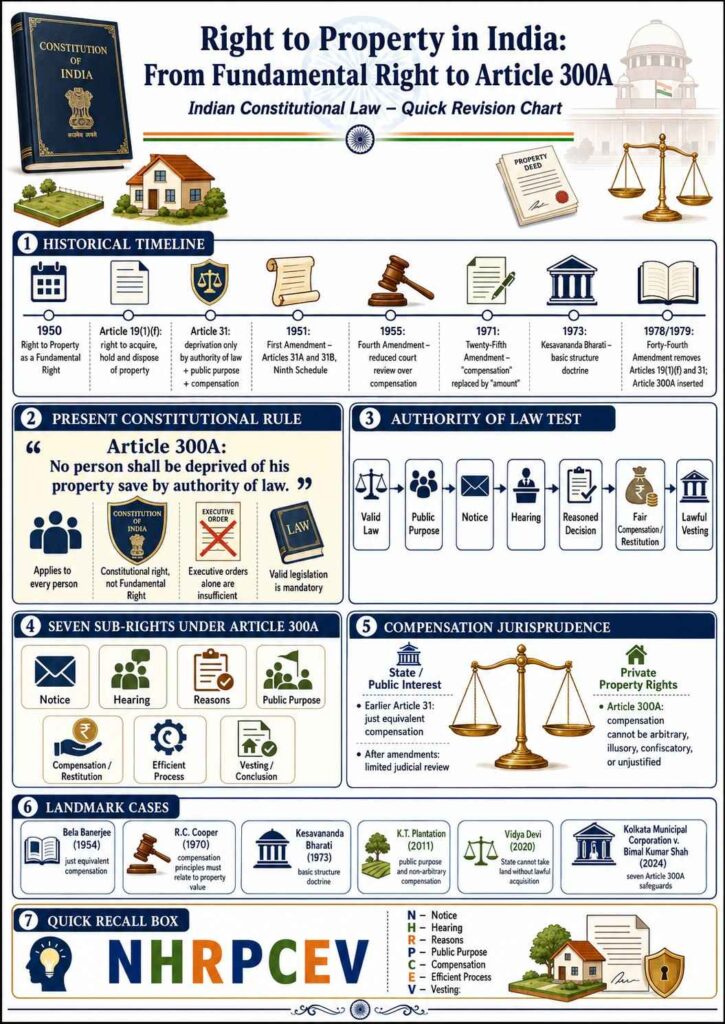
Meaning and Constitutional Position of the Right to Property
- Property: Property is not confined to land, houses, or physical objects. It includes legally recognised interests such as ownership rights, leasehold interests, mineral rights, shares, contractual interests, copyrights, and other intangible proprietary rights. The constitutional protection applies to the property-holder’s lawful interest, not merely to possession of land.
- Present Status: The right to property is no longer a Fundamental Right under Part III of the Constitution. It is now a constitutional right protected by Article 300A in Part XII of the Constitution. Article 300A provides: “No person shall be deprived of his property save by authority of law.” The use of the word “person” means that this protection is available not only to citizens, but also to non-citizens, companies, trusts, and other legal persons capable of holding property.
- Core Principle: The State may acquire, regulate, restrict, or take property for a legitimate public purpose, but it cannot do so merely through an administrative order, executive instruction, police action, circular, or government letter. There must be a valid law authorising the deprivation and the procedure under that law must be followed.
Right to Property as a Fundamental Right Before the Forty-Fourth Amendment
| Constitutional provision before 20 June 1979 | Nature of protection | Person protected |
|---|---|---|
| Article 19(1)(f) | Right to acquire, hold and dispose of property | Citizens only |
| Article 31(1) | No deprivation of property except by authority of law | Every person |
| Article 31(2) | Compulsory acquisition or requisition only for a public purpose and upon payment of compensation | Every person whose property was acquired |
- Dual Protection: Before the Forty-Fourth Amendment, property enjoyed two layers of constitutional protection. Article 19(1)(f) gave every citizen a Fundamental Right to acquire, hold and dispose of property. Article 31 separately protected every person from unlawful deprivation and required public purpose and compensation when property was compulsorily acquired.
- Restriction versus Acquisition: Article 19(1)(f) dealt with restrictions on a citizen’s freedom to own and deal with property. Article 31 dealt with deprivation, acquisition, requisition, and compulsory taking of property. Thus, a law affecting property could be challenged both as an unreasonable restriction under Article 19 and as an unconstitutional deprivation under Article 31.
- Public Purpose: Under the original Article 31(2), the State could compulsorily take property only for a public purpose. A public purpose broadly included projects such as public roads, irrigation, housing, infrastructure, public institutions, redistribution measures, and other objectives genuinely connected with community welfare.
Historical Development of Property Rights and Constitutional Amendments
Early Conflict Between Land Reform and Property Rights
- Land Reform Background: Soon after independence, State governments enacted zamindari abolition and agrarian reform laws to eliminate intermediaries, redistribute agricultural land, secure tenancy rights, and implement the Directive Principles of State Policy, especially Article 39(b) and Article 39(c).
- Constitutional Tension: Landowners frequently challenged such laws under Articles 14, 19(1)(f), and 31. This produced a continuing conflict between individual property rights and the State’s objective of social and economic redistribution.
First Constitutional Amendment, 1951
- Articles 31A and 31B: The Constitution (First Amendment) Act, 1951 inserted Articles 31A and 31B and created the Ninth Schedule. Article 31A protected certain laws concerning estates, agrarian reform, management of property, amalgamation of corporations, and related matters from challenge under specified Fundamental Rights. Article 31B protected laws listed in the Ninth Schedule.
- Purpose: These provisions were intended to protect land reform legislation from being invalidated merely because it affected property rights. Article 31A and Article 31B remain constitutionally relevant, although Ninth Schedule laws are now subject to basic-structure review in appropriate cases.
Fourth Constitutional Amendment, 1955
- Compensation Change: The Constitution (Fourth Amendment) Act, 1955 amended Article 31 to reduce judicial scrutiny over the adequacy of compensation. It permitted legislation to fix compensation or prescribe principles for determining compensation.
- Effect: The amendment sought to prevent courts from reassessing compensation merely because the owner considered the amount insufficient. However, it did not permit the legislature to adopt wholly arbitrary, irrelevant, discriminatory, or illusory principles of valuation.
Twenty-Fifth Constitutional Amendment, 1971
- Compensation Replaced by Amount: The Constitution (Twenty-Fifth Amendment) Act, 1971 replaced the word “compensation” in Article 31(2) with “amount.” This was intended to reduce the requirement that the owner receive the full market-equivalent value of the property.
- Article 31C: The amendment also inserted Article 31C to protect laws made for implementing Article 39(b) and Article 39(c) from challenge under Articles 14, 19, and 31. The provision reflected the constitutional effort to give priority to distributive justice and social welfare measures.
Forty-Second Amendment and Minerva Mills
- Expansion Attempt: The Constitution (Forty-Second Amendment) Act, 1976 attempted to extend Article 31C protection from laws implementing Article 39(b) and 39(c) to laws implementing any Directive Principle of State Policy.
- Invalidation: This expansion was struck down in Minerva Mills Ltd. v. Union of India, (1980) 3 SCC 625. The Supreme Court held that harmony and balance between Fundamental Rights and Directive Principles form part of the Constitution’s basic structure. Parliament cannot destroy Fundamental Rights entirely by giving unrestricted supremacy to Directive Principles.
Forty-Fourth Constitutional Amendment, 1978
- Major Constitutional Shift: The Constitution (Forty-Fourth Amendment) Act, 1978 omitted Article 19(1)(f), repealed Article 31, and inserted Article 300A. These changes became effective on 20 June 1979.
- Result: The right to property ceased to be a Fundamental Right and became a constitutional right. Article 19 currently shows the omission of clause (f), Article 31 stands repealed, and Article 300A is placed in Chapter IV of Part XII.
- Important Qualification: The Forty-Fourth Amendment did not completely remove constitutional protection for property. It preserved special safeguards in particular situations:
- Article 30(1A): When property of a minority educational institution is compulsorily acquired, the amount fixed must not restrict or abrogate the minority’s right to establish and administer the institution.
- Second Proviso to Article 31A(1): A person personally cultivating land within the applicable ceiling limit cannot be deprived of that land unless the law provides compensation at a rate not less than market value.
Landmark Supreme Court Cases Before Article 300A
State of West Bengal v. Bela Banerjee, AIR 1954 SC 170; (1954) SCR 558
- Facts and Issue: The State sought to acquire private property under a law that fixed compensation. The question was whether Article 31(2), as originally framed, required compensation that was genuinely equivalent to the value of the property taken.
- Ratio Decidendi: The Supreme Court held that the expression “compensation” meant a just equivalent of what the owner had lost. The Court could examine whether the principles of compensation were relevant to the value of the acquired property.
- Importance: This decision gave strong judicial protection to owners under the original Article 31(2) and contributed to Parliament’s decision to enact the Fourth Constitutional Amendment.
P. Vajravelu Mudaliar v. Special Deputy Collector for Land Acquisition, AIR 1965 SC 1017; (1965) 1 SCR 614
- Facts and Issue: The validity of the Land Acquisition (Madras Amendment) Act, 1961 was challenged because it prescribed a special and less favourable compensation method for property acquired for housing schemes.
- Ratio Decidendi: The Supreme Court held that even after the Fourth Amendment, compensation principles could not be arbitrary or discriminatory. The legislature could not prescribe a valuation method unrelated to the property acquired or create unjustified discrimination between similarly situated owners.
- Importance: The case established that the bar against questioning the adequacy of compensation did not eliminate judicial review where the compensation formula itself was constitutionally defective or discriminatory.
R.C. Cooper v. Union of India, (1970) 1 SCC 248; AIR 1970 SC 564
- Facts and Issue: The Banking Companies (Acquisition and Transfer of Undertakings) Act, 1969 nationalised fourteen major banks. Shareholders challenged the compensation mechanism under Article 31.
- Ratio Decidendi: The Supreme Court held that compensation principles must bear a reasonable relationship to the value of the property acquired. Compensation could not be illusory merely because Parliament had used a statutory formula.
- Importance: The decision reaffirmed meaningful scrutiny of compensation and was a major reason for the Twenty-Fifth Amendment, which replaced “compensation” with “amount.”
Kesavananda Bharati v. State of Kerala, (1973) 4 SCC 225
- Facts and Issue: The challenge concerned Kerala land reform laws and the constitutional validity of the Twenty-Fourth, Twenty-Fifth, and Twenty-Ninth Amendments.
- Ratio Decidendi: The Supreme Court evolved the basic structure doctrine. Parliament may amend the Constitution, including Fundamental Rights, but cannot damage or destroy its basic structure. The Court upheld Parliament’s broad amending power but invalidated the part of Article 31C that attempted to exclude judicial review completely.
- Importance: The case ensured that property-related constitutional amendments, land reform laws, and Ninth Schedule protections would remain subject to the basic structure limitation.
I.R. Coelho v. State of Tamil Nadu, (2007) 2 SCC 1
- Facts and Issue: The case concerned laws inserted into the Ninth Schedule after the basic structure doctrine had been developed.
- Ratio Decidendi: The Supreme Court held that every Ninth Schedule law inserted after 24 April 1973 may be reviewed if it damages or destroys the Constitution’s basic structure.
- Importance: Article 31B is not an absolute shield. Even land reform or acquisition legislation placed in the Ninth Schedule cannot escape review if it violates basic-structure principles.
Article 300A: Present Constitutional Protection
Text and Scope of Article 300A
- Textual Rule: Article 300A states that no person shall be deprived of property except by authority of law. It is substantially similar to the former Article 31(1), but it does not reproduce the former Article 31(2), which expressly mentioned public purpose and compensation.
- Deprivation: Deprivation is wider than formal acquisition. It may include extinction of ownership, compulsory transfer, confiscation, unauthorised occupation, taking possession, vesting of rights in the State, or interference that substantially destroys a recognised proprietary interest.
- Authority of Law: “Authority of law” means a valid law enacted by a competent legislature. A government circular, executive order, departmental direction, administrative instruction, or unilateral entry in revenue records cannot by itself authorise deprivation of property.
Bishambhar Dayal Chandra Mohan v. State of Uttar Pradesh, (1982) 1 SCC 39
- Facts and Issue: The case arose from food-control measures involving seizure of wheat. The question was whether executive action affecting property could be sustained without a specific legal source.
- Ratio Decidendi: The Supreme Court stressed that the State and its officers cannot interfere with private rights unless they can point to a specific rule of law authorising their action. Executive power cannot substitute for statutory authority.
- Importance: The decision is a leading authority for the proposition that Article 300A prohibits deprivation of property by executive fiat.
Jilubhai Nanbhai Khachar v. State of Gujarat, 1995 Supp (1) SCC 596
- Facts and Issue: Former Girasdars and Barkhalidars challenged Gujarat legislation vesting rights in mines, minerals, and quarries in the State.
- Ratio Decidendi: The Supreme Court held that Article 300A protects property against deprivation without legal authority. The right is a constitutional right, not a Fundamental Right and not part of the basic structure. The Court upheld the law because the deprivation was supported by legislation.
- Importance: The decision explains that Article 300A revives the rule-of-law aspect of former Article 31(1): where there is no valid law, there can be no lawful deprivation. It also confirms that Article 32 cannot ordinarily be invoked solely for violation of Article 300A; the normal constitutional remedy lies before the High Court under Article 226.
Public Purpose, Fair Procedure, and Compensation Under Article 300A
K.T. Plantation Pvt. Ltd. v. State of Karnataka, (2011) 9 SCC 1
- Facts and Issue: The case concerned the Roerich and Devika Rani Roerich Estate (Acquisition and Transfer) Act, 1996, under which the State acquired land, art objects, and related property. The Court examined the constitutional validity of the acquisition and the scope of compensation under Article 300A.
- Ratio Decidendi: The Supreme Court held that Article 300A does not expressly reproduce Article 31(2), but compulsory deprivation must ordinarily be for a public purpose. A law cannot simply declare that no compensation will be paid. Though Article 300A does not guarantee market-value compensation in every case, the State must justify nil, nominal, or reduced compensation by reference to the statute’s object, public interest, and constitutionally valid grounds.
- Just, Fair and Reasonable Standard: The Court stated that a law depriving a person of property must not be arbitrary, excessive, disproportionate, or contrary to the rule of law. It must be just, fair, and reasonable when examined with Articles 14, 19(1)(g), 26(b), 301, and other relevant constitutional guarantees.
- No Compensation and Nil Compensation: There is an important distinction:
- No compensation: A law acquiring private property for public purpose cannot validly state that no compensation will be paid.
- Nil compensation: In exceptional circumstances, nil compensation may be justified, for example where the State assumes liabilities charged on the property. The burden lies on the State to justify such a law.
Vidya Devi v. State of Himachal Pradesh, (2020) 2 SCC 569
- Facts and Issue: The State had taken possession of a widow’s land for construction of a road without initiating lawful acquisition proceedings or paying compensation. The owner approached the Court after a substantial delay.
- Ratio Decidendi: The Supreme Court held that the State cannot take private property without following a lawful acquisition procedure. Delay and laches cannot legitimise continuing unconstitutional possession by the State.
- Importance: The Court treated the right to property as both a constitutional right and a human right. It directed payment of compensation and reaffirmed that a welfare State must act fairly when dealing with private property.
Seven Sub-Rights Under Article 300A
Kolkata Municipal Corporation v. Bimal Kumar Shah, 2024 SCC OnLine SC 968; 2024 INSC 435
- Facts and Issue: Kolkata Municipal Corporation claimed to have acquired private property under Section 352 of the Kolkata Municipal Corporation Act, 1980. The Court found that the provision did not confer a power of compulsory acquisition and lacked a proper acquisition procedure.
- Ratio Decidendi: The Supreme Court held that compensation alone cannot validate compulsory acquisition. A valid deprivation must satisfy a complete constitutional procedure. The Court described Article 300A as a network of interconnected protections and held that absence of essential safeguards makes the action vulnerable to challenge.
- Seven Sub-Rights: The Court identified the following non-exhaustive safeguards:
| Memory aid | Sub-right | Meaning |
|---|---|---|
| N | Notice | Clear and meaningful prior notice of the proposed acquisition |
| H | Hearing | Genuine opportunity to raise objections |
| R | Reasons | A reasoned decision after considering objections |
| P | Public purpose | Acquisition must be for a legitimate public purpose |
| C | Compensation / restitution | Fair compensation and, where applicable, rehabilitation |
| E | Efficient process | Proceedings must be completed within prescribed timelines |
| V | Vesting / conclusion | Final lawful conclusion and vesting of property rights |
- Importance: The decision makes clear that acquisition cannot occur by surprise or through an incomplete statutory process. Notice, hearing, reasoned decision, public purpose, compensation, timely procedure, and final vesting together give substantive content to Article 300A.
Compensation Jurisprudence: Earlier and Present Position
| Period | Constitutional position on compensation |
|---|---|
| Original Article 31(2) | Compensation was expressly required for compulsory acquisition; courts examined whether it was a just equivalent |
| After Fourth Amendment | Adequacy was less open to challenge, but arbitrary or irrelevant valuation principles could still be reviewed |
| After Twenty-Fifth Amendment | “Compensation” was replaced by “amount”; full market equivalence was not constitutionally guaranteed |
| After Forty-Fourth Amendment | Article 300A does not expressly mention compensation, but public purpose, fairness, non-arbitrariness, and non-illusory restitution remain constitutionally reviewable |
- Present Rule: Article 300A does not create an automatic constitutional entitlement to market value in every form of deprivation. However, when the State compulsorily acquires private property, compensation cannot be illusory, arbitrary, or a device for confiscation.
- Statutory Entitlement: The actual amount, method, and components of compensation depend primarily on the acquisition statute. For ordinary land acquisition by the State, the Right to Fair Compensation and Transparency in Land Acquisition, Rehabilitation and Resettlement Act, 2013 is especially important.
- 2013 Act Safeguards: The 2013 Act provides statutory protections including social impact assessment, preliminary notification, objections, determination of market value, solatium, rehabilitation, and resettlement. Its structure reflects the procedural requirements later emphasised under Article 300A.
Remedies for Violation of Article 300A
- Article 226 Remedy: A person deprived of property without authority of law can ordinarily approach the High Court under Article 226 for writ relief, including mandamus, certiorari, restoration of possession, direction for lawful acquisition, or payment of compensation.
- Article 32 Limitation: Since Article 300A is not a Fundamental Right, Article 32 is generally not available solely for its violation. However, where the same State action also violates a Fundamental Right, such as Article 14 or Article 21, constitutional remedies may arise on those independent grounds.
- Civil and Statutory Remedies: Affected persons may also pursue remedies under the relevant acquisition statute, seek reference for enhancement of compensation where available, challenge notifications, claim damages, or institute civil proceedings depending on the facts and the governing legislation.
Key Takeaways
- Fundamental Right Removed: Article 19(1)(f) and Article 31 were removed by the Forty-Fourth Amendment with effect from 20 June 1979.
- Constitutional Right Retained: Article 300A continues to protect every person from deprivation of property without authority of law.
- Executive Fiat Prohibited: Administrative action alone cannot lawfully deprive a person of property.
- Public Purpose Required: Compulsory acquisition must ordinarily serve a genuine public purpose.
- Compensation Remains Relevant: Article 300A does not expressly guarantee market-value compensation in every situation, but the State cannot impose confiscatory, arbitrary, illusory, or unjustified deprivation.
- Fair Procedure Essential: Notice, hearing, reasons, public purpose, fair compensation, timely procedure, and final vesting are integral safeguards under Article 300A.