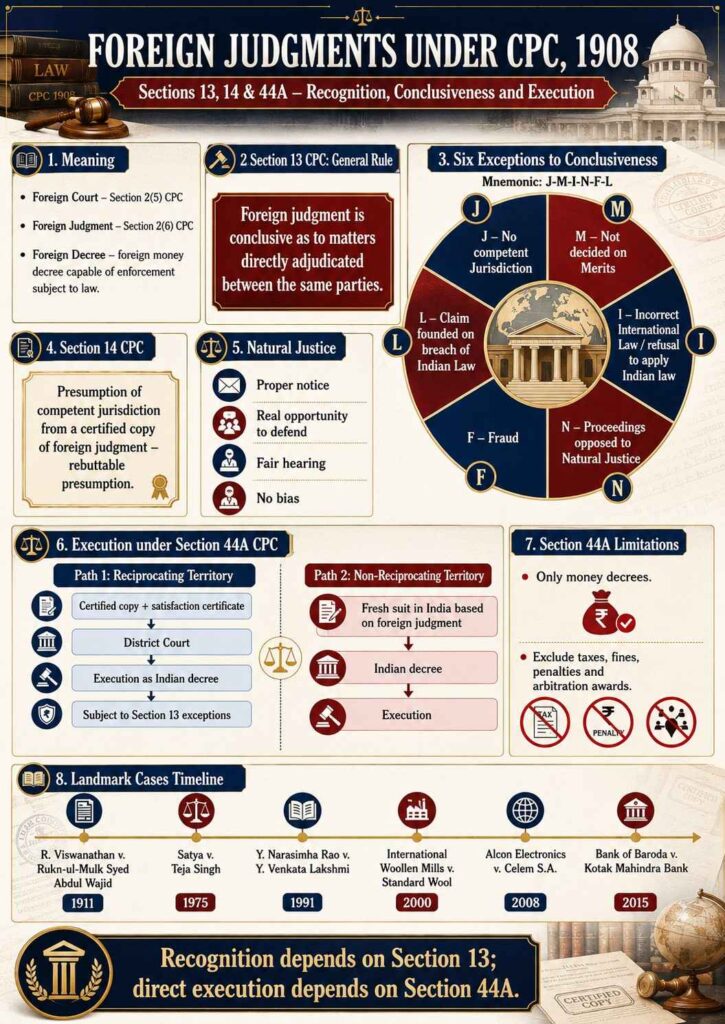
Meaning and Scope of Foreign Judgment
• Foreign Court: Section 2(5) CPC defines a foreign Court as a Court situated outside India which is not established or continued by the authority of the Central Government. Thus, the expression depends not only on geographical location but also on the authority by which the Court is constituted.
• Foreign Judgment: Under Section 2(6) CPC, a foreign judgment means the judgment of a foreign Court. A “judgment” under Section 2(9) CPC is the statement of grounds given by a Judge for a decree or order. Therefore, a foreign judgment includes the reasoned adjudication of a Court outside India.
• Foreign Decree: The CPC does not separately define “foreign decree” in Section 2. However, for Section 44A CPC, “decree” has a special meaning. It includes a decree or judgment of a notified superior Court under which a sum of money is payable, subject to statutory exclusions.
• Recognition and Execution: Recognition means that an Indian Court accepts a foreign judgment as binding regarding the matter actually decided. Execution means enforcement through Indian judicial machinery, such as attachment and sale of property. A foreign judgment may be recognised under Section 13 but may not always be directly executable under Section 44A.
• Comity of Nations: Indian Courts generally respect final judgments of foreign Courts as a matter of international comity. However, comity does not mean blind enforcement. Section 13 CPC protects Indian legal policy, procedural fairness, and the rights of the judgment-debtor.
Conclusiveness of Foreign Judgments under Section 13 CPC
• General Rule: Section 13 CPC makes a foreign judgment conclusive regarding a matter directly adjudicated between the same parties, or persons claiming under them, litigating under the same title. The judgment is not conclusive only when one or more of the six statutory exceptions applies.
• Direct Adjudication: The foreign judgment binds parties only on the precise right or issue actually determined. Incidental observations, collateral findings, assumptions, or matters that were not truly decided do not become conclusive.
• Same Parties and Same Title: The parties in the Indian proceeding must be the same as those before the foreign Court, or must claim through those parties under the same legal title. A person cannot ordinarily be bound by a foreign judgment if they were neither a party nor a lawful successor of a party.
• Effect Similar to Res Judicata: A conclusive foreign judgment prevents the parties from reopening the matter directly adjudicated. However, Section 13 is not identical to Section 11 CPC. It is a separate statutory rule governing the recognition of foreign adjudications.
• No Appeal on Merits: An Indian Court does not sit as an appellate Court over a foreign judgment. It will not re-assess evidence merely because it may have reached another conclusion. The inquiry is limited to the exceptions in Section 13.
• Leading Case — R. Viswanathan v. Rukn-ul-Mulk Syed Abdul Wajid, AIR 1963 SC 1; (1963) 3 SCR 22: The dispute concerned the effect in Madras of a judgment of the Mysore High Court concerning properties and shares connected with a deceased person’s estate. The Supreme Court considered whether the earlier judgment had directly adjudicated the disputed rights and whether the Court was competent in the international sense. It held that a foreign judgment is conclusive only concerning the right actually adjudicated, not every issue incidentally connected with the litigation. It further held that competence must exist both under the law constituting the Court and in the international sense recognised by private international law.
Exceptions to Conclusiveness under Section 13 CPC
Foreign Judgment by a Court without Competent Jurisdiction — Section 13(a)
• Jurisdiction Test: A foreign judgment is not conclusive if it was not pronounced by a Court of competent jurisdiction. Competence is tested not merely by the domestic law of the foreign country but also by principles of private international law recognised in India.
• International Competence: A foreign Court may generally have international competence where the defendant was resident or domiciled within its jurisdiction, voluntarily submitted to its jurisdiction, appeared and contested on merits without protest, or agreed by contract to submit disputes to that Court. Mere service of foreign summons upon a person in India does not automatically establish international jurisdiction.
• Jurisdictional Facts: The foreign Court’s own statement that it has jurisdiction is not always final. Indian Courts may examine the jurisdictional facts, especially where the foreign Court was induced to assume jurisdiction by fraud or misrepresentation.
• Judgment in Rem and Judgment in Personam: A judgment in rem determines the legal status of a person or property and may affect persons beyond the parties. A judgment in personam determines personal rights and obligations between the parties. Even a judgment in rem must be delivered by a competent Court.
• R. Viswanathan Principle: The Supreme Court clarified that foreign jurisdiction must be competent in an international sense. The Court also explained that the expression “matter” in Section 13 means the right claimed and actually adjudicated, not merely the broad subject matter of the dispute.
Foreign Judgment Not Given on Merits — Section 13(b)
• Meaning of Merits: A judgment is on merits when the foreign Court applies its judicial mind to the truth or validity of the claim after considering pleadings, evidence, documents, or the material placed before it.
• Ex Parte Decree: An ex parte foreign decree is not automatically invalid. The decisive question is whether the Court considered the claimant’s case and material before granting relief. A decree passed mechanically only because the defendant did not appear, without examination of the claim, is not a judgment on merits.
• Default Judgment: A default judgment passed merely as a penalty for non-appearance, non-filing of defence, or procedural default may fail the Section 13(b) test. The foreign Court must have undertaken a real adjudicatory exercise.
• Leading Case — International Woollen Mills v. Standard Wool (U.K.) Ltd., (2001) 5 SCC 265; AIR 2001 SC 2134: An Indian buyer allegedly received inferior wool supplied by a foreign seller. The seller obtained an ex parte money decree in the Central London County Court and sought execution in India. The legal issue was whether the foreign decree was given “on merits.” The Supreme Court held that an ex parte decree can be on merits only where the foreign Court considered evidence or material supporting the claim. A decree passed solely because of the defendant’s absence, without judicial consideration of the claim, is not conclusive under Section 13(b).
Incorrect View of International Law or Refusal to Apply Indian Law — Section 13(c)
• Two Grounds: A foreign judgment is not conclusive where it appears on the face of the proceedings that it is founded either on an incorrect view of international law or on a refusal to recognise Indian law in a case where Indian law applies.
• Facial Error Requirement: The defect must appear from the proceedings or judgment itself. The clause is not a general licence to challenge every legal error made by a foreign Court.
• Applicable Indian Law: This exception is important where Indian law clearly governs the dispute, such as an Indian personal law issue, a transaction governed by Indian statutory law, or a dispute involving rights created exclusively under Indian law.
• Public Policy Protection: The clause prevents parties from obtaining a foreign judgment by avoiding Indian law that should properly govern the dispute.
Proceedings Opposed to Natural Justice — Section 13(d)
• Core Principle: Natural justice requires procedural fairness. The most important components are adequate notice, a genuine opportunity to be heard, the right to present one’s case, and an impartial adjudicating authority.
• Audi Alteram Partem: The rule means that no person should be condemned unheard. Service of summons is important, but formal service alone may not be enough where the defendant had no real chance to defend.
• Impartial Tribunal: Proceedings are opposed to natural justice where the Judge was biased, personally interested, dishonest, or otherwise incapable of deciding impartially.
• Not Every Procedural Difference: Indian Courts do not reject a foreign judgment merely because foreign procedure differs from Indian procedure. The defect must offend the basic requirements of fairness and justice.
• R. Viswanathan Principle: The Supreme Court held that a foreign judgment may be treated as a nullity when it results from bias or partiality. At the same time, an Indian Court should not lightly presume unfairness merely because it disagrees with the foreign Court’s conclusion or procedure.
Foreign Judgment Obtained by Fraud — Section 13(e)
• Fraud Vitiates Adjudication: A judgment obtained by fraud is not conclusive. Fraud may concern the merits of the claim, suppression of material facts, forged material, false evidence, or jurisdictional facts.
• Jurisdictional Fraud: Fraud relating to the very basis on which the foreign Court assumed jurisdiction is particularly serious. For example, falsely claiming domicile or residence in a foreign country to secure a divorce may make the judgment unenforceable in India.
• Leading Case — Satya v. Teja Singh, (1975) 1 SCC 120; AIR 1975 SC 105: A Hindu husband went to Nevada, obtained a divorce decree after asserting that he was domiciled there, and relied upon it to resist his wife’s maintenance claim in India. The Supreme Court found that he had gone to Nevada only to obtain a convenient divorce and had not acquired genuine domicile there. The issue was whether the Nevada decree could be recognised in India. The Court held that fraud regarding jurisdictional facts is sufficient to deny recognition under Section 13. A foreign Court’s jurisdiction must exist in reality, not be created through false assertions.
Claim Founded on Breach of Indian Law — Section 13(f)
• Indian Law Safeguard: A foreign judgment is not conclusive where it sustains a claim founded on breach of any law in force in India.
• Nature of Exception: The focus is on the foundation of the claim. Where the very right enforced by the foreign Court is based on conduct prohibited by Indian law, the Indian Court may refuse recognition.
• Illustration: A foreign decree cannot be enforced where its enforcement would effectively validate a transaction, obligation, or claim prohibited by a mandatory Indian statute.
• Limited Review: Section 13(f) does not permit an Indian Court to reopen every foreign legal finding. It applies where the claim itself is founded on a breach of Indian law.
Presumption as to Foreign Judgments under Section 14 CPC
• Rebuttable Presumption: Section 14 CPC provides that when a document purporting to be a certified copy of a foreign judgment is produced, the Indian Court shall presume that the foreign judgment was pronounced by a Court of competent jurisdiction.
• Limited Presumption: The presumption relates only to jurisdiction. It does not automatically prove that the judgment was on merits, free from fraud, consistent with natural justice, or compliant with Indian law.
• Burden of Rebuttal: The party challenging the foreign judgment may rebut the presumption by proving want of jurisdiction. The presumption is displaced where the lack of jurisdiction appears from the record itself or is proved by evidence.
• Practical Value: Section 14 helps a decree-holder begin with a presumption in favour of jurisdiction, but the judgment-debtor can still invoke any of the six Section 13 exceptions.
Natural Justice in Foreign Judgments
• Notice: The defendant must receive sufficient and meaningful notice of the proceedings. Notice should enable the person to understand the nature of the claim and the time available for response.
• Effective Opportunity: Natural justice means more than formal service. The defendant must have a realistic opportunity to appear, engage counsel, file pleadings, present evidence, and contest the relief.
• No Mechanical Orders: A foreign Court should not issue an order merely because one party is absent, without considering whether the claimant has established a valid legal basis for relief.
• Bias and Fairness: A judgment resulting from judicial bias, personal interest, or procedural unfairness is vulnerable under Section 13(d).
• Matrimonial Proceedings: In family disputes, natural justice receives a stricter application because marriage, divorce, custody, and personal status affect fundamental civil rights. The foreign Court must ensure that the absent spouse had a genuine and effective chance to contest the proceedings.
Foreign Decree and Execution under Section 44A CPC
| Basis | Reciprocating Territory | Non-Reciprocating Territory |
|---|---|---|
| Primary remedy | Direct execution under Section 44A CPC | Fresh substantive suit on the foreign judgment |
| Court approached | District Court in India | Competent Indian civil Court |
| Nature of relief | Foreign money decree or judgment within Section 44A | Indian decree after adjudication in the fresh suit |
| Section 13 applicability | Court must refuse execution if Section 13 exception is proved | Court examines Section 13 before granting an Indian decree |
| Limitation | Cause-country limitation plus Article 137 principles | Article 101, Limitation Act: three years from judgment |
Direct Execution from a Reciprocating Territory
• Reciprocating Territory: A reciprocating territory is a country or territory outside India declared by the Central Government, through an Official Gazette notification, to be a reciprocating territory for Section 44A. The notification also specifies the “superior Courts” whose decrees qualify.
• District Court Filing: The decree-holder must file a certified copy of the foreign decree in the District Court. The decree may then be executed as though it had been passed by that District Court.
• Satisfaction Certificate: Along with the certified copy, the decree-holder must file a certificate from the foreign superior Court stating the extent to which the decree has been satisfied or adjusted. This certificate is conclusive proof of satisfaction or adjustment for Section 44A proceedings.
• Section 47 CPC: From the filing of the certified copy, questions relating to execution, discharge, or satisfaction are determined by the executing District Court under Section 47 CPC.
• Mandatory Refusal: The District Court must refuse execution if the judgment-debtor establishes any exception under Section 13(a) to Section 13(f). Thus, Section 44A creates a procedure for execution but does not override the safeguards of Section 13.
Scope and Limits of Section 44A
• Money Decree Requirement: Section 44A applies only where a sum of money is payable under the foreign decree or judgment.
• Excluded Amounts: It excludes sums payable as taxes, charges of a like nature, fines, or penalties.
• Arbitration Exclusion: An arbitration award is excluded even if it is enforceable as a decree or judgment in the country where it was made. Enforcement of foreign arbitral awards is governed by the Arbitration and Conciliation Act, 1996, particularly its provisions dealing with New York Convention and Geneva Convention awards.
• Non-Money Relief: A divorce decree, declaration of status, injunction, custody order, or decree for specific performance is not directly executable under Section 44A unless it independently falls within the statutory definition of a money decree.
• Leading Case — Alcon Electronics Pvt. Ltd. v. Celem S.A. of FOS, (2017) 2 SCC 253: A French company obtained an English Court order awarding costs against an Indian company in patent-related proceedings. The Indian company objected that the order was interlocutory and did not amount to a decree. The Supreme Court held that Section 44A has an independent enforcement mechanism and that the expression “decree” includes a foreign judgment under which money is payable. Since the foreign Court had given the parties an opportunity to present their case and had passed a reasoned order, the costs order was treated as conclusive and executable.
Execution of Decrees from Non-Reciprocating Territories
• No Direct Execution: A decree of a Court in a country not notified as a reciprocating territory cannot be directly executed under Section 44A CPC.
• Fresh Suit: The decree-holder must institute a fresh suit in India based on the foreign judgment. The foreign judgment creates the foundation of the claim, while Section 13 determines whether it is conclusive.
• Indian Decree: Once the competent Indian Court passes a decree in the fresh suit, that Indian decree is executed under ordinary CPC execution provisions.
• Limitation: Article 101 of the Limitation Act, 1963 prescribes three years for a suit upon a judgment, including a foreign judgment, computed from the date of the judgment.
Limitation for Execution under Section 44A
• Cause-Country Limitation: The foreign decree must remain executable under the limitation law of the reciprocating country in which it was passed.
• Article 136 Not Applicable: The twelve-year execution period under Article 136 of the Limitation Act applies to decrees of Indian Courts and does not automatically apply to foreign decrees executed under Section 44A.
• Article 137 Application: An execution application under Section 44A is governed by Article 137, which ordinarily provides three years from the date when the right to apply accrues.
• Leading Case — Bank of Baroda v. Kotak Mahindra Bank Ltd., (2020) 17 SCC 798: A London Court passed a money decree in favour of Bank of Baroda, which was sought to be executed in India after a substantial delay. The Supreme Court considered the limitation applicable to a foreign decree from a reciprocating territory. It held that the limitation law of the cause country governs whether the decree remains executable. It further held that the Indian application under Section 44A is governed by Article 137 and should ordinarily be filed within three years from the foreign decree; where genuine execution steps were first pursued in the cause country, the three-year period may run from finalisation of those proceedings.
Foreign Matrimonial Judgments
• Special Caution: Foreign decrees of divorce or annulment have serious consequences for marital status, maintenance, succession, and remarriage. Indian Courts examine them carefully under Section 13 CPC.
• Governing Personal Law: The jurisdiction assumed by the foreign Court and the ground on which relief is granted must generally be consistent with the matrimonial law under which the parties were married.
• Leading Case — Y. Narasimha Rao v. Y. Venkata Lakshmi, (1991) 3 SCC 451: The parties were married under Hindu rites in India. The husband obtained a divorce decree from a Missouri Court on the ground of irretrievable breakdown, while the wife had not voluntarily submitted to that jurisdiction. The Supreme Court held that the decree was not recognisable because the foreign Court lacked jurisdiction under the matrimonial law governing the marriage and relied on a ground unavailable under that law. The Court recognised limited exceptions: where the respondent was domiciled or habitually and permanently resident in the foreign forum; where the respondent voluntarily and effectively submitted to the foreign jurisdiction and contested; or where the respondent consented to the grant of relief.
Quick Revision Memory Aid
| Mnemonic: J-M-I-N-F-L | Section 13 Exception |
|---|---|
| J | No competent Jurisdiction |
| M | Not decided on Merits |
| I | Incorrect International law or refusal of applicable Indian law |
| N | Proceedings against Natural justice |
| F | Judgment obtained by Fraud |
| L | Claim founded on breach of Indian Law |
• Core Formula: A foreign judgment is ordinarily conclusive, but direct execution in India is available only for qualifying money decrees from notified reciprocating territories and only after surviving the Section 13 test.