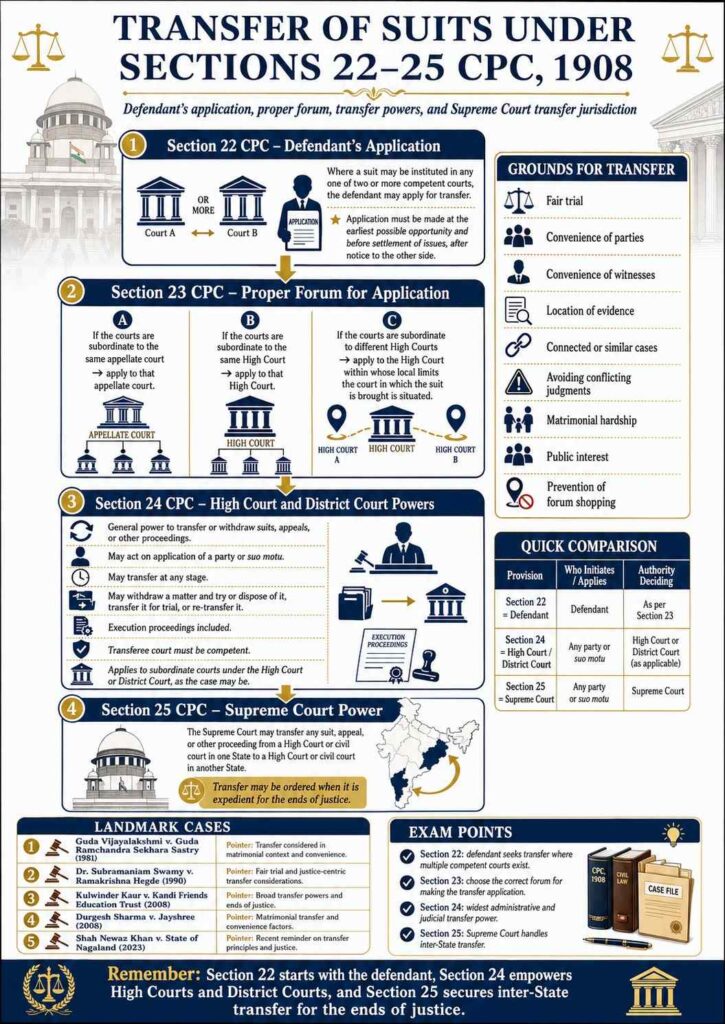
Meaning and Purpose of Transfer of Suits
• Transfer of suit: Transfer means shifting a pending suit, appeal, execution proceeding, or other civil proceeding from one competent court to another competent court for fair, convenient, and effective adjudication.
• Underlying objective: Sections 22 to 25 of the Code of Civil Procedure, 1908 regulate transfer so that jurisdiction is not used oppressively, parties receive a fair opportunity of hearing, witnesses and evidence can be conveniently produced, connected disputes are not decided inconsistently, and justice is not defeated merely because litigation is filed at an inconvenient place.
• Statutory scheme: Sections 22 to 25 form the principal statutory framework on civil transfer. Section 22 concerns a defendant’s request where more than one court has jurisdiction; Section 23 identifies the forum for such request; Section 24 gives the High Court and District Court broad powers of transfer and withdrawal; and Section 25 gives the Supreme Court power to transfer matters across States.
• Key distinction: A transfer petition does not ordinarily decide whether the original court actually has territorial or pecuniary jurisdiction. A party may raise a proper jurisdictional objection before the court where the suit is pending. Transfer jurisdiction instead considers whether the matter should continue in one competent forum or be moved to another forum in the interests of justice.
Quick Jurisdiction Map for Transfer of Suits
| Situation | Relevant provision | Appropriate forum |
|---|---|---|
| Suit could have been instituted in two or more competent courts; defendant wants transfer | Section 22 read with Section 23 | Appellate Court or High Court specified by Section 23 |
| Transfer or withdrawal between courts subordinate to the same District Court or High Court | Section 24 CPC | District Court or High Court, as applicable |
| Transfer between courts subordinate to different High Courts | Section 25 CPC | Supreme Court |
| Inter-State transfer where both courts are subordinate to a common High Court under Article 231 | Section 24 CPC | Common High Court |
| Transfer from one State to another where each State has its own High Court | Section 25 CPC | Supreme Court |
• Memory aid — “22 Defendant, 23 Forum, 24 High Court/District Court, 25 Supreme Court”: This sequence helps identify both the person who may apply and the authority competent to decide the request.
Section 22 CPC: Transfer by Defendant’s Application
• Scope: Section 22 applies where a suit may lawfully be instituted in any one of two or more courts and the plaintiff chooses one of those courts. The section permits a defendant to request that the suit be transferred to another court which also has jurisdiction. Thus, Section 22 does not apply where the proposed transferee court lacks jurisdiction over the subject matter, pecuniary value, territorial cause of action, or parties.
• Applicant: Only a defendant may invoke Section 22. A plaintiff cannot invoke Section 22 to shift a suit filed by himself or herself. The Supreme Court has clarified that Sections 22 and 23 operate in the limited setting contemplated by Section 22 and may be invoked by a defendant alone.
• Notice requirement: The defendant must give notice to the other parties before applying. This protects the plaintiff and other defendants from an ex parte change of forum.
• Time requirement: The application must be made at the earliest possible opportunity. Where issues have been settled, the application must be made at or before settlement of issues. Delay is important because a defendant who participates substantially in the litigation may be treated as having accepted the chosen forum.
• Nature of inquiry: The court considers objections of the other parties and determines which among the several competent courts should proceed with the suit. The enquiry is not whether the chosen court is legally incompetent; rather, it is which competent court is the most appropriate forum.
• Forum conveniens: Section 22 embodies the idea of forum conveniens, meaning the most suitable and convenient forum. Relevant circumstances may include the location of parties, witnesses, documents, cause of action, property, connected litigation, and practical cost of conducting the trial.
• Illustration: A contracts suit may be filed either where the contract was executed or where it was to be performed. If the plaintiff files the suit at one competent place but all witnesses, documents, and business records are at the other competent place, a defendant may seek transfer under Section 22 at the earliest stage.
• Section 22 is not a right to select a preferred court: The defendant cannot demand transfer merely because another court is personally more convenient. The request must disclose a genuine reason showing that the alternate competent court is more appropriate for justice.
Section 23 CPC: Court in Which the Transfer Application Lies
• Function: Section 23 does not independently create substantive transfer power. It merely identifies the proper forum to receive an application under Section 22. The substantive power and procedural framework must therefore be understood with Sections 22, 24, and 25.
• Same Appellate Court: Where all competent courts are subordinate to the same Appellate Court, the Section 22 application lies before that Appellate Court.
• Different Appellate Courts, same High Court: Where the competent courts are subordinate to different Appellate Courts but fall under the same High Court, the application lies before that High Court.
• Different High Courts — statutory text: Section 23(3) states that where the courts are subordinate to different High Courts, the application shall be made to the High Court within whose territorial jurisdiction the court where the suit was instituted is situated.
• Current legal position on Section 23(3): Despite its retained statutory wording, Section 23(3) cannot be treated as authorising one High Court to transfer a matter to a court subordinate to another High Court in the ordinary inter-State situation. For States having separate High Courts, such transfer falls within Section 25 and can be ordered by the Supreme Court. This is because a High Court ordinarily cannot exercise authority beyond its territorial jurisdiction.
• Common High Court exception: Where two or more States share a common High Court under Article 231 of the Constitution and both transferor and transferee courts are subordinate to that common High Court, the High Court may exercise Section 24 power even though the transfer is from one State to another.
Section 24 CPC: General Power of Transfer and Withdrawal
• Broad power: Section 24 gives the High Court and District Court a broad discretionary power to transfer or withdraw a suit, appeal, or other proceeding at any stage.
• Application or suo motu action: The High Court or District Court may act on an application by any party after notice and hearing. It may also act suo motu, that is, on its own motion, without issuing such notice. This makes Section 24 much wider than Section 22.
• Who may apply: Unlike Section 22, an application under Section 24 may be moved by any party, including a plaintiff, defendant, appellant, respondent, decree-holder, or judgment-debtor, depending on the nature of the proceeding.
• Transfer power under Section 24(1)(a): A High Court or District Court may transfer a suit, appeal, or other proceeding pending before it to a court subordinate to it and competent to try or dispose of the matter.
• Withdrawal power under Section 24(1)(b): The High Court or District Court may withdraw a suit, appeal, or proceeding pending before a court subordinate to it. After withdrawal, it may:
- Try or dispose of the matter itself;
- Transfer it to another subordinate competent court; or
- Re-transfer it to the original court.
• Competent transferee court: The court receiving the matter must ordinarily be competent to try or dispose of it. Transfer cannot confer substantive jurisdiction upon a court that lacks the legal competence to decide the dispute.
• Proceeding includes execution: Section 24 expressly states that “proceeding” includes a proceeding for execution of a decree or order. Therefore, an execution case may also be transferred or withdrawn under Section 24.
• Additional and Assistant Judges: Courts of Additional Judges and Assistant Judges are deemed subordinate to the District Court for purposes of Section 24.
• Small Cause Court: When a suit is transferred or withdrawn from a Court of Small Causes, the transferee court is deemed to be a Court of Small Causes for that suit. This preserves the special procedural character of the matter.
• Transfer from an incompetent court: Section 24(5), inserted by the 1976 Amendment, permits transfer of a suit or proceeding even from a court that has no jurisdiction to try it. This provision prevents procedural waste where the matter is pending before an incompetent court but can appropriately be transferred to a competent court. The transferee court must nevertheless possess jurisdiction to try the matter.
• Stage after transfer: Under Section 24(2), the transferee court may, subject to special directions in the transfer order, either retry the matter or continue from the stage at which it was transferred or withdrawn.
• No fixed limitation period: Section 24 may be invoked “at any stage.” However, delay, participation in proceedings, tactical conduct, or an attempt to derail the trial may persuade the court to reject the request.
Withdrawal under Section 24 CPC
• Meaning of withdrawal: Withdrawal is not abandonment of the suit. It means taking the pending matter away from a subordinate court and bringing it before the High Court or District Court.
• Purpose of withdrawal: Withdrawal may be appropriate where common legal questions arise in multiple proceedings, where complex issues require direct adjudication by the High Court, where connected cases require coordinated disposal, or where transfer to another subordinate court is necessary after withdrawal.
• Re-transfer power: A withdrawn case need not remain permanently with the withdrawing court. The High Court or District Court can re-transfer it to the original court or send it to another competent subordinate court.
• Effect on evidence: A transfer order should ideally state whether the receiving court must begin afresh or proceed on the existing record. In the absence of a special direction, Section 24(2) allows the transferee court to choose between retrial and continuation from the existing stage.
Section 25 CPC: Supreme Court’s Power to Transfer Suits, Appeals and Proceedings
• Inter-State transfer power: Section 25 empowers the Supreme Court to transfer any suit, appeal, or other proceeding from a High Court or civil court in one State to a High Court or civil court in another State when such transfer is expedient for the ends of justice.
• Who may apply: Any party may apply under Section 25. This includes the plaintiff as well as the defendant.
• Procedure: The application must be made by a motion supported by an affidavit. The Supreme Court must issue notice and hear parties who desire to be heard before passing a transfer order.
• Stage: The Supreme Court may act at any stage of the matter. Transfer may therefore be sought before trial, during trial, at the appellate stage, or in an appropriate execution-related proceeding.
• Ends of justice test: The controlling statutory expression is whether transfer is “expedient for the ends of justice.” It is deliberately broad and cannot be reduced to a rigid formula.
• Law applicable after transfer: Section 25(5) provides that the applicable law remains the law which the court where the matter was originally instituted ought to have applied. A change of venue should not change the substantive law governing the dispute.
• Frivolous petitions: If the Supreme Court dismisses a transfer application as frivolous or vexatious, it may award compensation to the opposing party. The statutory ceiling remains ₹2,000 under Section 25(4).
• Historical development: The present Section 25 was substituted by the Code of Civil Procedure (Amendment) Act, 1976 with effect from 1 February 1977. The earlier provision vested limited transfer power in the State Government. The amendment transferred this judicial function to the Supreme Court and substantially expanded the scope of inter-State transfer.
Grounds for Transfer of Suits
• Fair trial: A genuine and reasonable apprehension that a party will not receive a fair trial is a strong ground. Mere suspicion, personal dislike, or unsupported allegations against a court, advocate, or opposite party are insufficient.
• Balance of convenience: The court considers inconvenience to parties, witnesses, and persons holding documentary evidence. Distance, financial hardship, illness, disability, lack of support, and the practical difficulty of producing evidence may be relevant.
• Location of evidence: Transfer may be justified where the bulk of oral evidence, public records, business records, property records, or material witnesses are located at the proposed transferee place.
• Connected proceedings: Transfer may be warranted where two matters involve substantially identical parties, facts, documents, or legal issues and separate trials may lead to inconsistent findings.
• Avoiding multiplicity: Consolidated or coordinated disposal may save evidence, reduce costs, prevent contradictory decrees, and secure a more complete adjudication.
• Public interest: A matter involving broad public concern, sensitive local circumstances, or an important question affecting numerous persons may call for transfer where justice so requires.
• Matrimonial hardship: In matrimonial proceedings, the convenience, financial position, safety, caregiving responsibilities, and practical hardship of the wife are important factors. This is not an automatic rule that every petition must be transferred to the wife’s place; the court still assesses the overall interests of justice.
• Bad faith or forum shopping: A transfer petition may be rejected where it is filed only to delay the case, avoid an inconvenient order, harass the other side, choose a perceived favourable court, or reopen issues already substantially progressed.
Landmark Supreme Court Decisions
• Guda Vijayalakshmi v. Guda Ramchandra Sekhara Sastry, (1981) 2 SCC 646: The wife had instituted maintenance proceedings in Andhra Pradesh, while the husband later instituted divorce proceedings in Rajasthan. She sought transfer of the matrimonial matter to Andhra Pradesh. The issue was whether Sections 21 and 21A of the Hindu Marriage Act curtailed the Supreme Court’s power under Section 25 CPC. The Supreme Court held that a matrimonial proceeding is covered by the expression “suit, appeal or other proceeding” under Section 25 and that the Hindu Marriage Act did not exclude or limit the Supreme Court’s transfer power. The decision establishes that special matrimonial procedure does not, by itself, take away the Supreme Court’s broad Section 25 jurisdiction where transfer is required for justice.
• Dr. Subramaniam Swamy v. Ramakrishna Hegde, (1990) 1 SCC 4: A defamation suit was filed in the Bombay High Court, while most alleged transactions, documents, and witnesses were in Karnataka. The defendant sought transfer to Bangalore. The issue was whether the plaintiff’s choice of forum as dominus litis should prevail over the defendant’s request. The Supreme Court transferred the matter, holding that the paramount test under Section 25 is the ends of justice. The plaintiff’s forum choice is relevant, but it cannot override the need for a fair and practically workable trial. The Court emphasised that mere personal convenience is not enough; the applicant must show that the chosen forum would prejudice fair adjudication or materially impair the ability to defend the case.
• Kulwinder Kaur v. Kandi Friends Education Trust, (2008) 3 SCC 659: A dispute concerning the management of an educational trust was pending at Ropar. The High Court transferred the suit to Chandigarh without recording adequate reasons. The Supreme Court set aside the transfer order and remanded the matter. It held that Section 24 confers comprehensive transfer power, exercisable at any stage and even suo motu, but the discretion must be used carefully, cautiously, and with recorded reasons. The Court identified relevant considerations such as convenience of parties and witnesses, location of evidence, reasonable apprehension of lack of justice, public interest, and the overall interests of justice. A transfer order cannot rest on a bare assertion or judicial ipse dixit.
• Durgesh Sharma v. Jayshree, (2008) 9 SCC 648: The husband instituted divorce proceedings in Madhya Pradesh, while related matrimonial litigation was pending in Maharashtra. The Madhya Pradesh High Court ordered inter-State transfer under Section 23(3). The issue was whether one High Court could transfer a matter from a court subordinate to it to a court subordinate to another High Court. The Supreme Court held that Sections 22 to 25 are exhaustive on transfer; Section 23 merely identifies the forum for a Section 22 application and does not itself confer substantive transfer power. Where courts are subordinate to different High Courts, transfer ordinarily lies only before the Supreme Court under Section 25. The Court also held that Section 151 CPC cannot be used to bypass the express statutory scheme.
• Shah Newaz Khan v. State of Nagaland, 2023 INSC 176; (2023) 3 SCR 985: The plaintiffs sought transfer of a civil suit from Dimapur, Nagaland to Guwahati, Assam. Both courts were subordinate to the Gauhati High Court, which was a common High Court under Article 231 of the Constitution. The issue was whether Section 25 made the Supreme Court the exclusive authority for every inter-State civil transfer. The Supreme Court held that Section 24 may be exercised by a common High Court for an inter-State transfer where both courts are subordinate to that High Court. Section 25 governs the usual inter-State situation where the two States have separate High Courts under Article 214. This judgment creates an important constitutional exception to the ordinary rule explained in Durgesh Sharma.
• Sumita Singh v. Kumar Sanjay, (2001) 10 SCC 41: The wife sought transfer of matrimonial proceedings from Ara, Bihar to Delhi, stating that she was working in Delhi, would have to travel approximately 1,100 kilometres, and had no practical accommodation at Ara. The Supreme Court allowed transfer and treated the wife’s practical convenience as a significant consideration in matrimonial litigation. The ratio is not that the wife automatically succeeds in every transfer petition; rather, genuine hardship, distance, financial ability, safety, support systems, and the realities of litigation must receive serious weight.
Important Comparative Distinctions
• Section 22 versus Section 24: Section 22 is restricted to a defendant and applies where multiple courts already have jurisdiction. Section 24 is broader, may be invoked by any party, applies at any stage, and also permits suo motu transfer or withdrawal.
• Section 23 versus Section 24: Section 23 identifies the forum for a Section 22 request. Section 24 grants substantive transfer and withdrawal power to the High Court and District Court.
• Section 24 versus Section 25: Section 24 operates within the judicial hierarchy of the same High Court or District Court. Section 25 is the Supreme Court’s inter-State transfer power, subject to the exception of a common High Court exercising Section 24 over courts subordinate to it.
• Transfer versus withdrawal: Transfer shifts a proceeding directly to another court. Withdrawal first brings the proceeding before the High Court or District Court, which may then retain, transfer, or re-transfer it.
• Jurisdiction objection versus transfer request: A jurisdiction objection challenges the competence of the court. A transfer application generally accepts that the court may be competent but seeks a more suitable forum for justice.
Conclusion
• Central principle: The ultimate test under Sections 22 to 25 CPC is not the personal preference of a litigant but the proper administration of justice.
• Practical rule: A party seeking transfer should clearly show the existing court, proposed transferee court, jurisdiction of the transferee court, stage of proceedings, connected matters, material witnesses, documentary evidence, hardship, and specific facts demonstrating why transfer would serve justice.
• Judicial discipline: Transfer is a discretionary remedy. Courts must avoid both extremes: refusing a necessary transfer that would impair a fair trial, and allowing transfer merely because one party wants a more convenient or strategically advantageous forum.